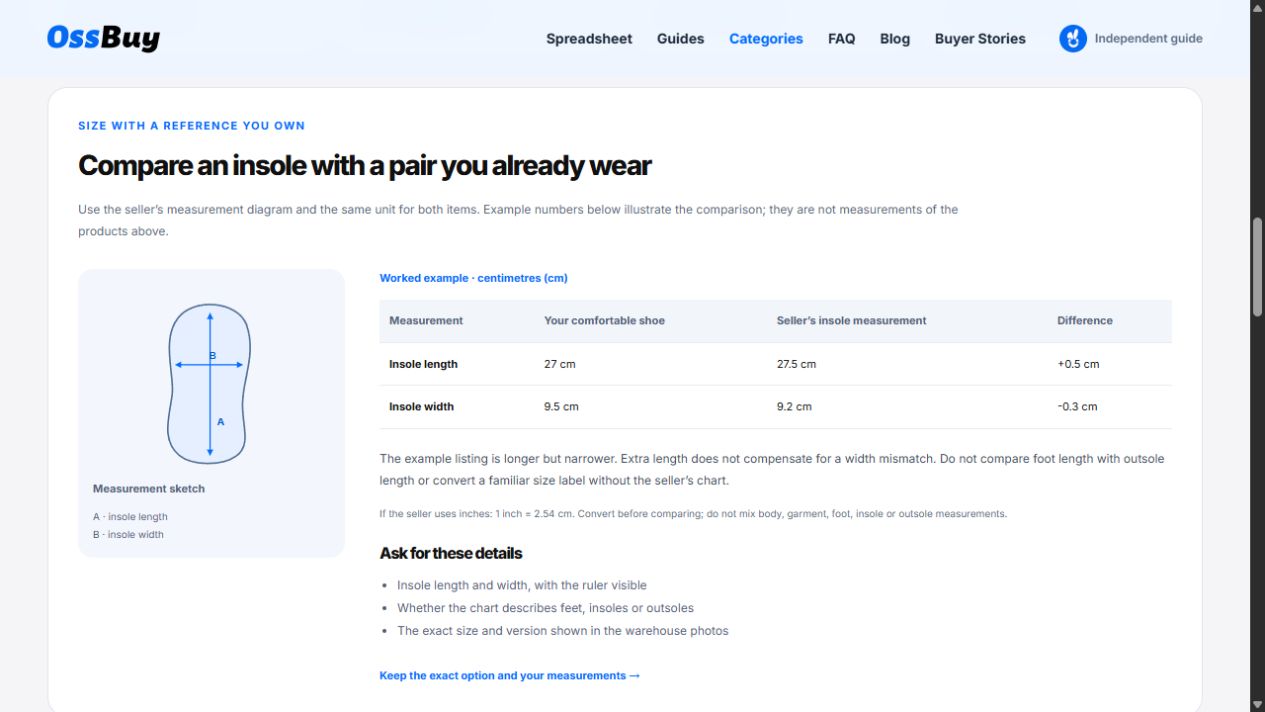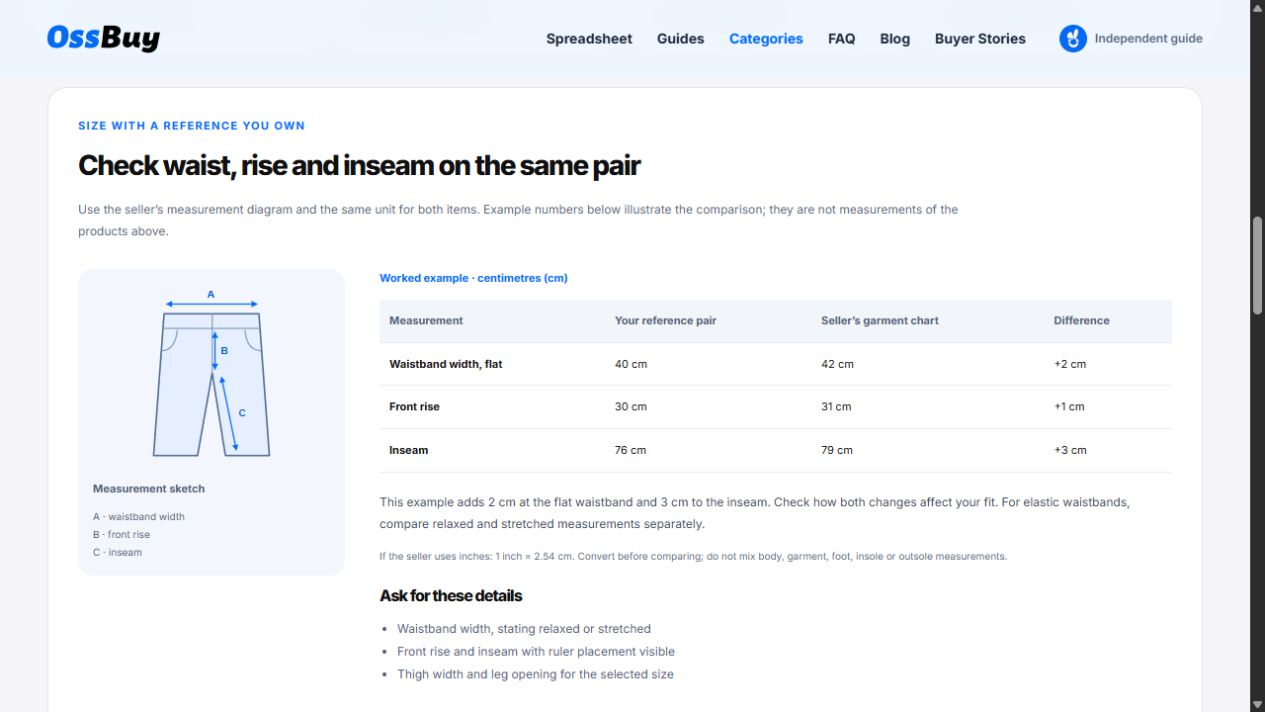

Compare the finished garment with a hoodie that already fits you, using the same units and measurement points. Check width, length and sleeves together. A larger label, a wider chest or a single photograph cannot settle all three.
On this page · 9 sections
Choose a reference that fits the way you want
If you like how a hoodie you own fits, its measurements give you a more concrete starting point than a familiar S, M or L label. Use a reference with the proportions and layering room you want. A close-fitting tee is a poor reference for a roomy winter hoodie.
Lay the reference garment flat, smooth it without stretching it, and use the seller’s diagram to identify the comparison points. Record the unit and how each measurement was taken. This is a method for comparing dimensions, not a guarantee that two garments will feel or drape alike.
Is pit-to-pit the same as chest circumference?
| Number on a chart | What it may describe | How to use it |
|---|---|---|
| Pit-to-pit / half chest / flat chest | One flat width across a finished garment, using stated points. | Compare with the same width on a reference garment. |
| Garment chest circumference | Distance around the finished garment’s chest section. | Confirm whether the seller measured around it or doubled a flat width. |
| Body chest circumference | The wearer’s body measurement. | Use only with a chart explicitly intended for body measurements. |
| Recommended weight or height | A seller’s general size suggestion. | Ask for actual garment dimensions when width or length matters. |
For example, a flat chest width of 60 cm corresponds approximately to 120 cm around that garment section. It is not a recommendation for a 120 cm body chest. Do not compare a seller’s “chest 60” with your body circumference until the seller explains the unit and measurement type.
If you own a hoodie with the fit you want, use its finished dimensions as your first reference. That comparison still leaves fabric stretch, cut and drape to check; arithmetic does not supply those missing properties.
Compare the same three measurements
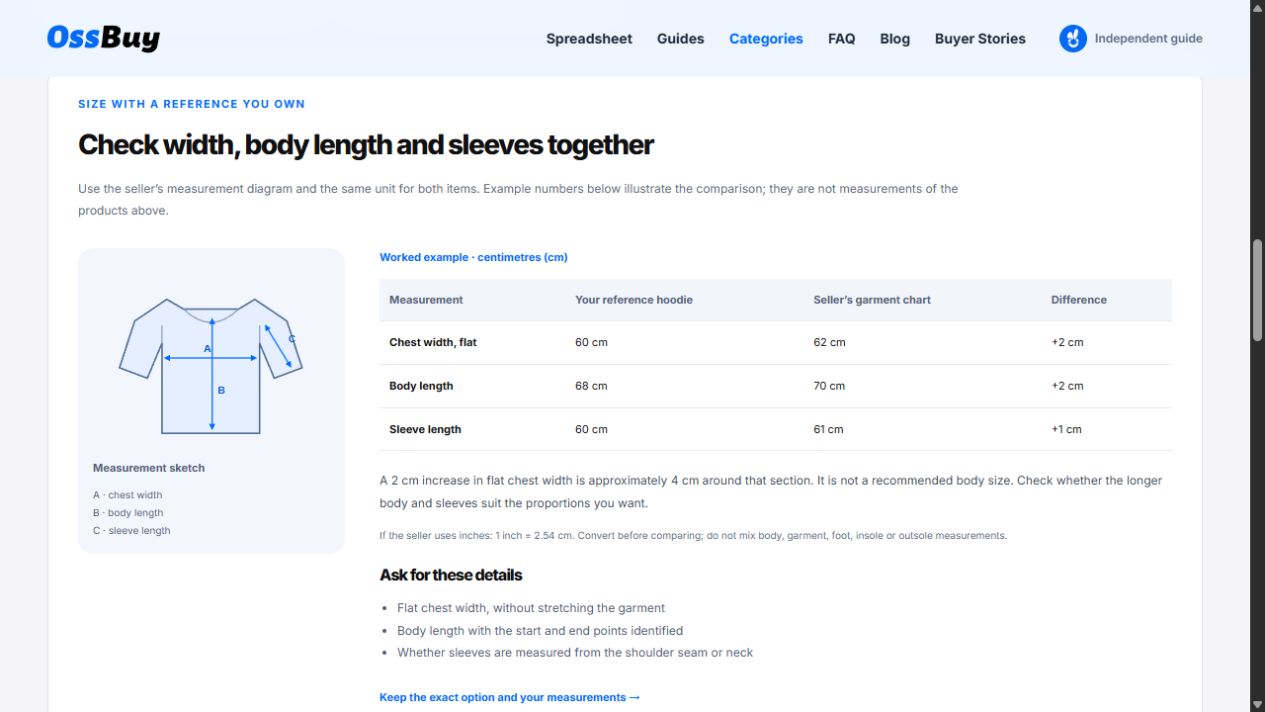
- Flat chest width: compare the same underarm-to-underarm points with the garment closed where relevant. Do not compare a flat garment width directly with body circumference.
- Body length: identify the start and end points. A measurement from the shoulder and one from the back neck may describe different distances.
- Sleeve length: check whether the seller starts at the shoulder seam or the neck. A dropped shoulder makes this distinction especially useful.
Write the method beside the number. “Sleeve: 61 cm, from shoulder seam” tells you more than “sleeve: 61”. If the seller’s chart does not explain its points, keep the comparison unresolved and ask for a diagram or ruler photo.
How should you compare hoodie sleeve length?
First identify the construction and the seller’s start point. A set-in sleeve can be measured from the shoulder seam to the cuff. Another chart may measure from the centre back neck through the shoulder to the cuff. A raglan sleeve may use a different seam reference. These are different paths; two values with the same unit are not automatically comparable.
- Find the seller’s diagram for the exact garment and size.
- Place your reference garment flat and follow that same path.
- Include the cuff consistently; record whether it is folded or unfolded.
- If the start point is absent, ask for a labelled ruler photo instead of estimating a conversion.
A dropped shoulder can move the seam down the arm. A shorter shoulder-seam-to-cuff measurement can therefore coexist with a roomy shoulder shape. Ask for shoulder placement or the corresponding full sleeve path when the diagrams differ. Do not add a guessed constant to make incompatible methods agree.
Work through a measurement comparison
| Measurement | Your reference | Example chart | Difference |
|---|---|---|---|
| Chest width, flat | 60 cm | 62 cm | +2 cm |
| Body length | 68 cm | 70 cm | +2 cm |
| Sleeve, same method | 60 cm | 61 cm | +1 cm |
The example chart is wider, longer and slightly longer in the sleeve. Doubling the flat chest difference gives approximately 4 cm around that section; it does not identify a recommended body size. Consider all three changes together. A wider hoodie can still be too long for the silhouette you want.
These numbers are deliberately illustrative. They are not taken from any product in the spreadsheet and should not be copied into an order as that product’s dimensions. Record the actual chart and selected size in your comparison notes instead.
What if the chest fits but the hoodie is too long?
| Option | Flat chest / body / sleeve | What the comparison tells you |
|---|---|---|
| Teaching option A | 62 / 70 / 61 cm | Adds width, body length and sleeve length. Consider all three changes. |
| Teaching option B | 64 / 76 / 64 cm | Adds more width and substantially more length. It may not suit a short, boxy silhouette. |
| Only “oversized M” is supplied | Dimensions unknown | The fit question is unresolved; request the chart before selecting a size. |
These options are invented for the comparison and are not sizes of the products below. If you want more width with little added body length, look for that combination in the actual chart. Moving up one size is only useful if the changes match your intended proportions.
For layering, choose a reference hoodie you already wear over the intended base layer. Check the hem and cuff shape as well as the main dimensions. Write your own acceptance criteria, such as “keep the body near the reference length”, rather than adopting a universal extra-centimetre rule from an unrelated garment.
What if the size chart and QC measurements disagree?
- Confirm identity: is the photo for the correct listing, colour, version and size tag?
- Confirm method: are the ruler start and end points visible, the unit the same, and the garment laid without pulling?
- Repeat the disputed measurement: request a wider photo showing the whole garment and ruler, then a readable close-up if needed.
- Compare with your needs: use the repeat result and the seller’s stated tolerance, if one is supplied. Do not invent a tolerance to dismiss a difference.
- Resolve before proceeding: ask the seller or agent about the available next step and current terms if the result does not meet your requirements.
For example, a chart showing 62 cm flat chest and a photo apparently showing 58 cm is a question to resolve. The 4 cm flat difference is approximately 8 cm around that section. It may reflect a wrong option or a different ruler path; the photo alone does not establish which explanation is correct.
Apply the questions to two real hoodie listings
These two actual source records are discovery candidates. Their photos and observed prices are available; selected-size measurements, material performance and personal shipping quotes remain unconfirmed here.
 Photo unavailable
Supreme Grey Hoodie with White Logo
Hoodies & fleece
$39.47 USDCaptured
View on MaisonLooks ↗ Photo unavailable
Polo Ralph Lauren Grey Zip-Up Hoodie
Hoodies & fleece
$33.73 USDCaptured
View on MaisonLooks ↗Source photos are catalogue references, not warehouse QC or product-test evidence. Each source opens MaisonLooks in a new tab.
The source cards let you compare the observed names, photos and prices. They do not supply the chest, body or sleeve dimensions used in the teaching examples. Before choosing either listing, request its own selected-size chart and keep the measurement method beside each number.
A measurement request with useful context
For [exact link], [colour / version], size [label], please show flat chest width, body length from [start point] to hem, and sleeve length from [start point] to cuff. Include the full ruler and garment in the photo. My reference garment measures [your figures] using these same points. Please explain any difference from the chart.
More hoodie sizing questions
Should I size up for an oversized hoodie?
Compare proportions first. If the listing is already wide, the next size may add length you do not want. Use actual width, length and sleeve figures against an oversized garment you already like.
Can I compare inches with centimetres?
Yes, after converting. Multiply inches by 2.54 to get centimetres: 24 inches is 60.96 cm. NIST defines the inch as exactly 25.4 mm. The measurement points and garment/body distinction must still match.
Will a hoodie shrink after washing?
These source records do not establish a shrinkage rate. Ask for the actual fabric composition, care instructions and any supplied dimensional-change evidence for that item. Do not add a made-up shrink allowance to the size choice.
Can QC photos prove a winter hoodie is warm?
Photos can show visible construction and measurements. They do not establish insulation performance, feel or long-term durability. Keep those questions separate from the sizing comparison and ask for item-specific information.
Sources & scope
- NIST: SI units of length
Supports the exact inch-to-millimetre conversion. The fit examples and decision steps are our own educational comparisons.
External references checked on 24 October 2026. Product capture dates are shown separately on their source cards.
Put it into practice
Browse hoodies & sizing examples →Editorial note: this article documents this site’s tools, source records and labelled educational examples. It is not a buyer review or a report of product testing. See how this independent guide works.